Where to Search for Gold with a Metal Detector
Gold detecting is not just about owning a good detector. The most successful prospectors spend far more time researching locations than they do actually swinging the coil. Understanding geology, historical mining activity, terrain, and detector selection dramatically increases your chances of finding gold.
In this guide, we will cover how to identify promising gold locations, what geological signs to look for, and which types of metal detectors work best in different conditions.
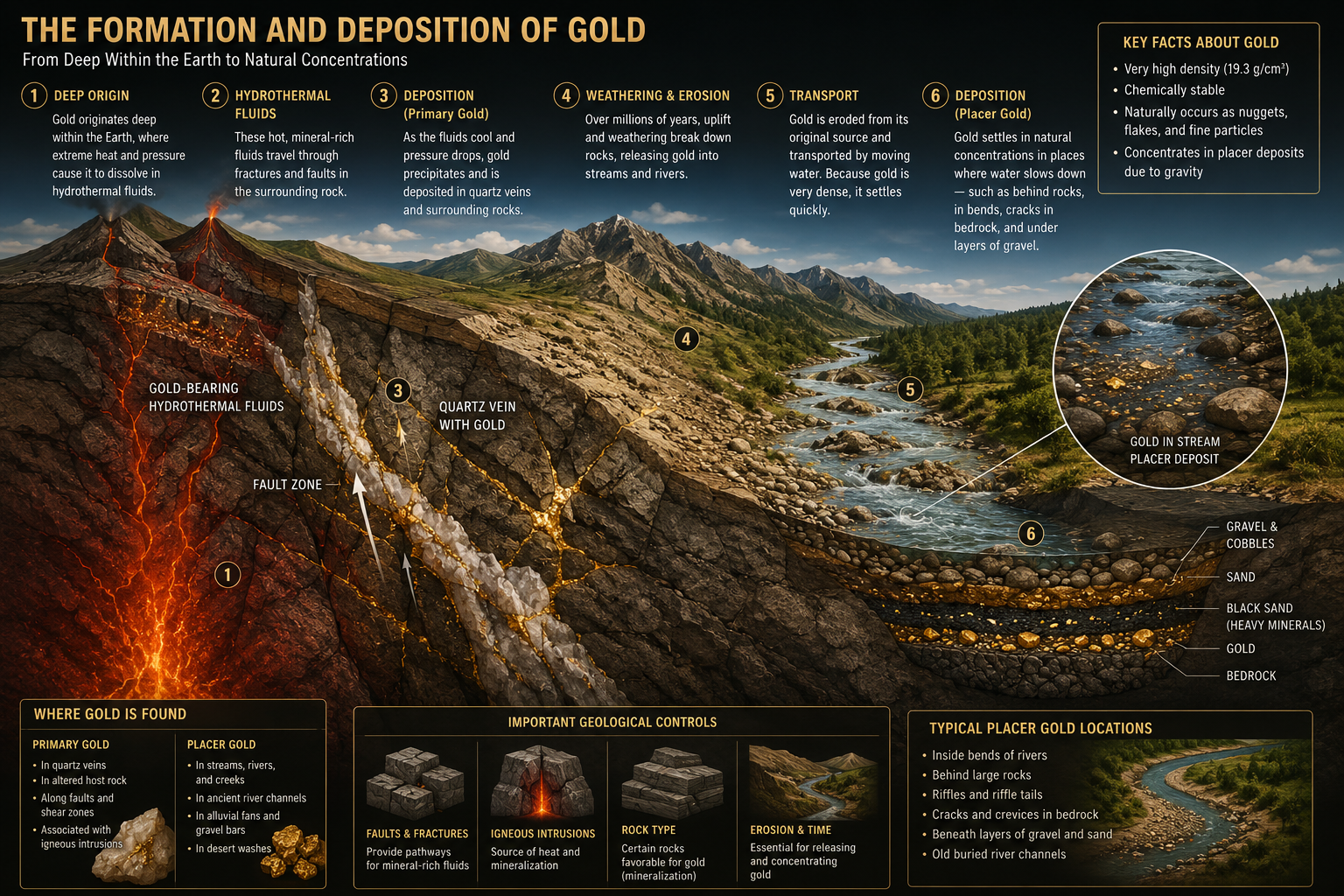
Understanding How Gold Forms
Before searching for gold, it is important to understand why gold appears in certain places.
Natural gold is typically found in two major forms:
- Primary gold deposits (hard rock gold)
- Secondary gold deposits (placer gold)
Primary deposits are gold veins still trapped inside rock formations, often quartz veins. Secondary deposits occur when erosion breaks down these veins over thousands or millions of years, transporting gold into rivers, creeks, and sediment layers.
Most hobby detectorists search for placer gold because it is easier to access and recover.
The Best Places to Search for Gold
Old Goldfields and Historic Mining Areas
Historic gold mining districts are usually the best places to start.
If miners recovered gold there 100 or 200 years ago, there is still a strong chance that missed nuggets remain in the ground. Early miners had limited technology compared to modern detectors.
Research:
- Old mining maps
- Historical newspapers
- Geological survey reports
- Mining claim databases
- Abandoned mining settlements
- Old dredging or hydraulic mining zones
Look for evidence such as:
- Tailing piles
- Drywasher piles
- Old shafts
- Quartz rubble
- Rusted mining equipment
- Hand-stacked rocks
Many successful modern gold hunters search directly around old workings rather than completely untouched ground.
Creeks, Rivers, and Placer Deposits
Gold is heavy, which means water naturally concentrates it in predictable locations.
When searching rivers and creeks, focus on areas where water velocity decreases and heavy material settles.
Good targets include:
- Inside bends of rivers
- Bedrock cracks
- Natural riffles
- Gravel bars
- Waterfalls and drop zones
- Crevices behind large rocks
- Ancient river channels
Gold often sinks until it reaches hard bedrock. If you find exposed bedrock with cracks, that is usually an excellent sign.
Ancient River Channels
Some of the richest gold deposits in history came from ancient buried river systems.
Over geological time, rivers may shift or become buried under sediment and volcanic material. These paleochannels can contain extremely rich placer deposits.
Research methods include:
- Geological maps
- Satellite imagery
- Elevation maps
- Mining reports
- Academic geological studies
Ancient channels are often found:
- Along hillsides
- Under red clay layers
- Beneath volcanic basalt
- Near historical hydraulic mining sites
These locations may require larger coils or deep-seeking detectors.
Quartz Veins and Hard Rock Areas
Gold commonly forms alongside quartz veins.
Not every quartz vein contains gold, but areas with extensive quartz activity are worth investigating, especially when combined with known mineralization.
Look for:
- White quartz outcrops
- Iron staining
- Red or orange soils
- Black mineralization
- Sulfide minerals
- Fractured host rock
Geological indicators frequently associated with gold include:
- Magnetite
- Hematite
- Pyrite
- Schist
- Greenstone belts
- Fault lines
- Shear zones
A detector can locate gold specimens and shallow quartz-hosted nuggets near the surface.
Desert Goldfields
Many famous goldfields are located in arid environments.
Deserts preserve nuggets exceptionally well because erosion is slower and vegetation is limited.
Focus on:
- Dry creek beds
- Washes
- Alluvial fans
- Exposed bedrock
- Hills below quartz reefs
Desert detecting is often ideal for Pulse Induction (PI) detectors because mineralized ground can be extremely harsh.
Mountainous Terrain
Mountain regions often expose ancient geology and eroded gold systems.
Search areas:
- Below quartz-rich slopes
- Near exposed bedrock
- Along mountain streams
- On benches above rivers
- Near landslide zones
Heavy rainfall can continuously expose new gold-bearing ground over time.
Geological Clues That Suggest Gold
Understanding geology gives you a major advantage over random searching.
Ironstone and Mineralized Ground
Gold is frequently associated with iron-rich soils and mineralization.
Look for:
- Red dirt
- Black sand
- Ironstone gravel
- Magnetite concentrations
Many productive goldfields contain highly mineralized ground that challenges basic VLF detectors.
Black Sand Concentrations
Black sand is a strong indicator because it contains heavy minerals that settle similarly to gold.
If you find:
- Magnetite
- Hematite
- Garnet-rich black sands
then the area may also trap gold.
Black sand alone does not guarantee gold, but it is an important clue.
Fault Lines and Geological Contacts
Gold-bearing fluids historically traveled through cracks and faults in the earth.
Important geological structures include:
- Fault lines
- Shear zones
- Contacts between rock types
- Folded rock formations
Geological maps can help identify these structures before visiting an area.
Research Tools Every Gold Hunter Should Use
Geological Survey Maps
Government geological agencies often provide free maps showing:
- Mineral occurrences
- Historical mines
- Rock types
- Fault structures
- Placer deposits
These maps are among the most valuable research tools available.
Satellite Imagery
Modern satellite imagery can reveal:
- Old diggings
- Dry creek systems
- Exposed bedrock
- Tailing piles
- Access roads
Google Earth is extremely useful for scouting potential sites remotely.
Historical Records
Old documents can contain surprisingly accurate information.
Useful sources include:
- Mining journals
- Historical newspapers
- Old topographic maps
- Mining claim records
- Local museum archives
Many forgotten goldfields can still produce nuggets today.
Choosing the Right Detector for Gold Hunting
Different environments require different detector technologies.
VLF Detectors
VLF (Very Low Frequency) detectors are highly sensitive to small gold.
Best for:
- Tiny nuggets
- Mild soil
- Bedrock crevices
- Shallow targets
Advantages:
- Excellent sensitivity
- Good discrimination
- Lightweight
- Lower cost
Disadvantages:
- Struggles in highly mineralized soil
- Reduced depth in difficult ground
Good situations for VLF:
- Small creek gold
- Bedrock sniping
- Tiny specimen hunting
Pulse Induction (PI) Detectors
PI detectors dominate serious gold prospecting in harsh ground.
Best for:
- Highly mineralized soil
- Large nuggets
- Deep targets
- Desert goldfields
Advantages:
- Exceptional depth
- Excellent ground handling
- Stable in mineralized terrain
Disadvantages:
- More expensive
- Poor discrimination
- Less sensitive to tiny gold compared to high-frequency VLF units
Good situations for PI:
- Australia-style ironstone ground
- Volcanic terrain
- Deep nugget hunting
- Salt-rich environments
High-Frequency Gold Detectors
Modern high-frequency detectors are designed specifically for tiny gold.
These machines excel at:
- Sub-gram nuggets
- Fine gold
- Specimen gold
- Trashy mining camps
However, they may sacrifice depth on larger nuggets.
Coil Selection Matters
The search coil can dramatically change detector performance.
Small Coils
Best for:
- Tiny gold
- Bedrock cracks
- Trashy areas
- Tight terrain
Advantages:
- Better sensitivity
- Improved target separation
Large Coils
Best for:
- Deep nuggets
- Open terrain
- Large targets
Advantages:
- Greater depth
- Better ground coverage
Disadvantages:
- Reduced sensitivity to tiny nuggets
- Heavier to swing
Understanding Ground Mineralization
One of the biggest mistakes beginners make is ignoring mineralization.
Highly mineralized soil can:
- Create false signals
- Reduce depth
- Mask gold targets
This is why proper ground balancing is critical.
In difficult terrain, PI detectors usually outperform standard VLF detectors.
Permissions and Legal Considerations
Always verify whether gold detecting is legal in your chosen area.
Research:
- Private land ownership
- Mining claims
- National parks
- Protected archaeological zones
- Permit requirements
Many productive areas require permission or mining access rights.
Common Beginner Mistakes
Searching Randomly
Successful gold prospecting is mostly research and geology.
Randomly detecting without understanding gold deposition usually produces poor results.
Ignoring Tiny Targets
Small and faint signals should never be ignored.
Many large nuggets are found after prospectors investigate weak, uncertain signals.
Giving Up Too Quickly
Goldfields can appear empty for hours before producing a nugget.
Persistence matters.
Experienced detectorists often revisit productive locations repeatedly from different directions and with different coils.
Final Thoughts
Finding gold with a metal detector is a combination of research, geology knowledge, patience, and proper equipment selection.
The best detector in the world cannot compensate for poor location choice. On the other hand, a skilled prospector with solid geological understanding can still find gold using modest equipment.
Study historical mining activity, learn to recognize favorable geology, analyze terrain carefully, and choose the detector technology that matches your environment.
The more you understand why gold exists in certain places, the more successful your gold hunting will become.