The Unseen Enemy - Understanding VLF Metal Detector Masking and Silent Masking
If you have been in the metal detecting hobby for a while, you have likely heard about target masking. It is one of the most widely misunderstood phenomena in detector performance, leading many detectorists to walk right over valuable coins, relics, and jewelry without ever hearing a sound.
If you have been in the metal detecting hobby for a while, you have likely heard about target masking. It is one of the most widely misunderstood phenomena in detector performance, leading many detectorists to walk right over valuable coins, relics, and jewelry without ever hearing a sound.
A common myth among hobbyists is that switching a Very Low Frequency (VLF) detector into All Metal Mode completely eliminates masking. To understand why this is physically impossible, we need to look back at one of the most influential articles written on the subject and break down the physics of electromagnetic signals under the coil.
The Legacy: Thomas Dankowski’s "Beneath the Mask"
In March 2000, veteran detectorist and engineer Thomas J. Dankowski published an article titled "Beneath the Mask" in Western & Eastern Treasures magazine. In this piece, Dankowski described controlled test garden experiments that shocked the metal detecting community.
Using a Fisher CZ-6a in virtually mineral-free soil, Dankowski buried a single, slightly rusted household staple directly over a US silver dime buried at 8.5 inches deep.
The results were eye-opening:
- Adjacent Masking: When the staple was placed at 1 inch deep over the dime, the detector responded with an "iron" audio signal. The silver dime was completely masked by the iron staple.
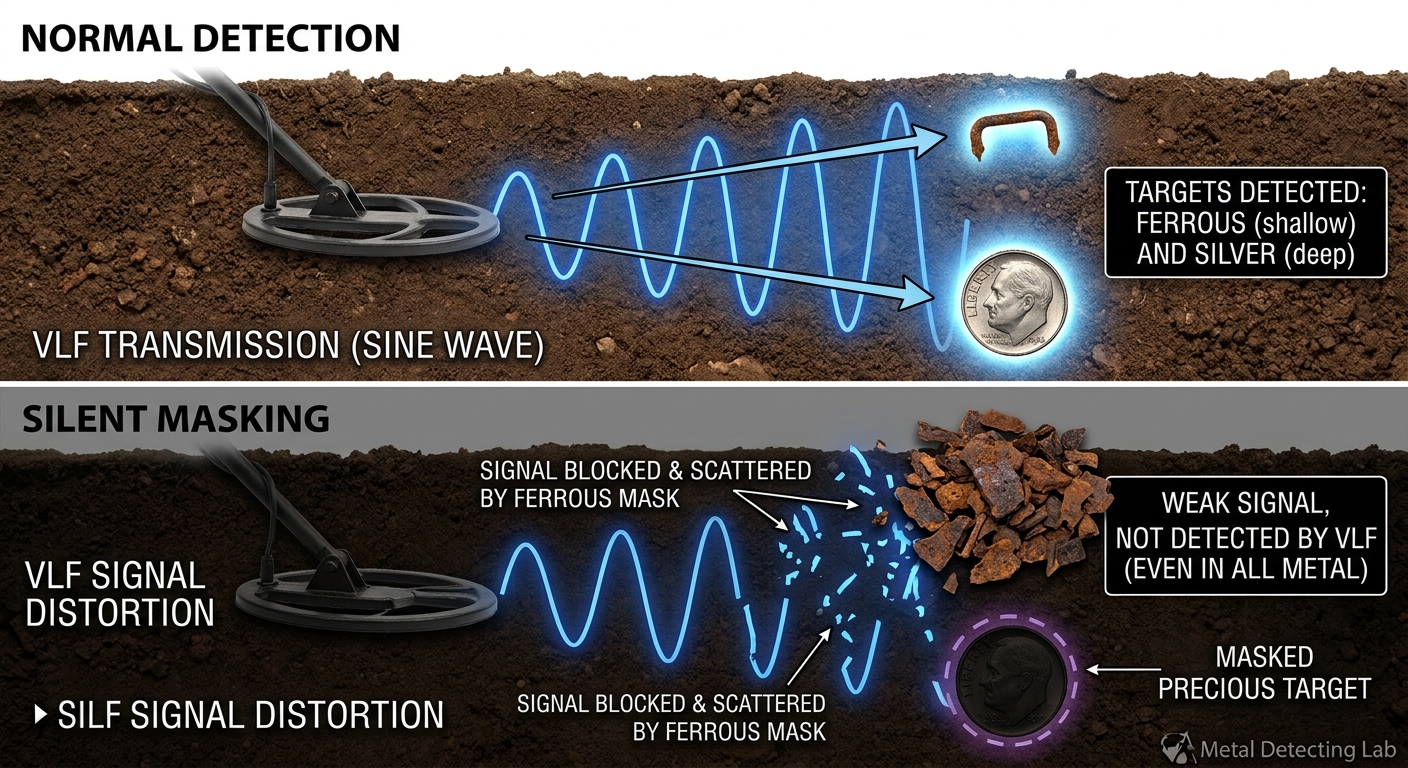
- Silent Masking: When the staple was moved deeper—between 3 and 6 inches deep—the detector went completely silent. The staple was too deep to trigger a clear iron response, yet shallow enough to disrupt the electromagnetic signal traveling down to the silver dime.
- The "Clean" Field Experiment: To prove how prevalent this issue is in the real world, Dankowski used a top-tier VLF detector in All Metal mode to completely "sanitize" a section of a public baseball field, recovering 9 coins. He then swept the exact same area using a high-powered Pulse Induction (PI) machine (a Minelab SD2200d). The PI machine pulled an additional 1,151 items of tiny iron trash and 39 additional coins that the VLF machine had missed due to severe iron masking.
Why Doesn't All Metal Mode Fix Target Masking?
It is natural to assume that turning off discrimination (running in All Metal mode) forces the machine to report every single metal object in the ground. While All Metal mode does disable audio suppression, it cannot overcome the laws of physics.
Masking is not a software restriction inside your detector; it is a physical cancellation of electromagnetic energy before it ever reaches the processing unit.
1. Vector Summing (Signal Blending)
Your search coil does not take two individual "snapshots" of targets within its field. It senses a single, combined electromagnetic response.
- A silver coin attempts to shift the signal's phase toward high conductivity.
- An iron nail attempts to shift the phase toward high magnetic permeability.
Because magnetic field strength drops off dramatically with distance (following an inverse-cube law), a piece of iron shallow in the ground creates a response hundreds of times stronger than a deep coin. The strong signal vector of the iron swallows and distorts the weak vector of the coin. The coil returns a single, blended signal to the detector, which reads as pure iron.
2. Signal Dispersal (Silent Masking)
When a tiny piece of ferrous trash sits directly between the coil and a deep coin, it acts as an electromagnetic shield. The energy transmitted by the coil hits the iron object and scatters. The faint energy that manages to pass through hits the coin and travels back up, only to be scattered a second time on its return path.
By the time the signal reaches the search coil, its amplitude falls below the detector's minimum threshold. The machine stays silent in both Discrimination and All Metal modes.
VLF vs. Pulse Induction (PI) in Heavy Trash
While VLF detectors transmit a continuous sine wave that is easily disrupted by small adjacent metals, Pulse Induction (PI) machines operate differently.
A PI detector sends high-energy magnetic pulses into the ground and measures the decay rate of induced eddy currents. High-end PI machines can punch through heavy mineral soil and ignore micro-trash that would otherwise trigger silent masking on a VLF.
However, even PI machines are not immune to target masking. If a large iron target and a non-ferrous target are within the same detection envelope, their decay curves blend together, making target identification extremely difficult.
How to Minimize Masking in the Field
While no VLF detector can see through solid iron to read a deep non-ferrous target cleanly, you can adopt several tactical approaches to reduce masking:
- Use Smaller Search Coils: An 11-inch concentric coil samples a large volume of dirt at once, increasing the chance of covering both iron and a good target simultaneously. Switching to a 5-inch or 6-inch coil reduces the ground volume sampled, allowing you to isolate good targets squeezed between trash.
- Opt for True Double-D (DD) Coils: DD coils produce a narrow, razor-like beam of detection from toe to heel. This narrow footprint offers vastly superior target separation compared to standard concentric coils.
- Change Your Sweep Angle: Always sweep a target from multiple directions (360 degrees). Approaching a target blend from a different angle may allow the coil to detect the non-ferrous target before the iron target enters the electromagnetic field.
- Listen for "Audio Distortion": On analog or fast-recovery machines, masked targets rarely sound completely clean. Train your ears to dig signals that exhibit a slight "zip," "scratch," or asymmetry at the edges of the sweep—these irregularities often indicate a good target hiding right next to iron.
Final Thoughts
Target masking is an inherent technological limitation of electromagnetic metal detection. Understanding that an empty, quiet patch of ground might actually be hiding targets under a layer of "silent maskers" changes the way you approach hunted-out sites.
By slowing down your sweep speed, utilizing smaller DD coils, and listening closely to signal textures, you can begin unlocking the valuable targets left behind by others.